
If you’ve been making soaps, candles, bath bombs, perfumes, room sprays, or other fragranced products, you’ve probably followed a recipe at some point. Recipes are a fantastic starting point for beginners because they’re easy to follow and require very little technical knowledge.
However, as your hobby grows into a business, you’ll eventually encounter a challenge that recipes simply cannot solve: consistency.
A recipe that works perfectly one day may produce slightly different results the next. Small variations in measuring techniques, ingredient density, and batch size can all impact your final product.
This is where formulation becomes essential.
Understanding the difference between a recipe and a formula is one of the most important steps you can take toward producing professional-quality products with reliable, repeatable results.
In this guide, we’ll explain the differences between recipes and formulas, show you how to convert a recipe into a formula, and demonstrate why percentage-based formulation is the industry standard for product development and manufacturing.
What Is the Difference Between a Recipe and a Formula?
Although the terms are often used interchangeably, recipes and formulas serve very different purposes.
What Is a Recipe?
A recipe is typically less precise and often uses units of volume.
Examples include:
- Cups
- Teaspoons
- Tablespoons
- Drops
Recipes are popular because they’re simple and accessible.
However, recipes have several limitations:
- Do not account for differences in ingredient density
- Do not account for specific gravity variations
- Often ignore maximum usage rates for restricted ingredients
- Can be difficult to scale accurately
- May produce inconsistent results between batches
Recipes work well for hobbyists making products for personal use, gifts, or small experimental batches.
What Is a Formula?
A formula uses precise measurements based on weight.
Common units include:
- Grams
- Ounces
- Kilograms
- Pounds
Formulas offer significant advantages:
- Precise measurements
- Repeatable results
- Easier quality control
- Consistent performance
- Scalable production
- Easier regulatory compliance
Most commercial manufacturers formulate products using percentages rather than volume measurements because percentages allow formulas to be scaled to virtually any batch size.
Why Recipes Become Problematic as Your Business Grows
Recipes may seem convenient, but they introduce variability into your production process.
For example, a recipe may call for:
1 cup coconut oilEven when carefully measured, one cup may contain slightly more or less product depending on:
- Temperature
- Packing density
- Measuring technique
- Ingredient consistency
These small variations may not matter when making products for yourself, but they become problematic when producing products for customers.
Consistency is one of the defining characteristics of a professional product line.
Customers expect the same experience every time they purchase your products.
Formulas help ensure that happens.
Benefits of Using Formulas Instead of Recipes
Converting recipes into formulas provides numerous benefits.
Improved Consistency
Every batch is produced using the same ratios and measurements.
Better Scalability
Formulas can be scaled up or down easily.
Easier Quality Control
Manufacturers can identify and correct issues more efficiently.
More Accurate Testing
Changes can be made systematically and repeated reliably.
Improved Regulatory Compliance
Percentage-based formulas make it easier to verify compliance with IFRA limits and other formulation requirements.
What Do You Need to Start Formulating?
Fortunately, you don’t need expensive laboratory equipment to begin formulating.
Basic Formulation Tools
You’ll need:
- A precise digital scale
- A calculator
- A notebook or spreadsheet
- Basic math skills
Many makers already have everything they need to start converting recipes into formulas.
How to Convert a Recipe to a Formula
The process of converting a recipe into a formula is surprisingly straightforward.
Step 1: Weigh Each Ingredient
Measure every ingredient individually using a scale.
Important:
Use the same unit of measurement throughout the entire process.
For example:
- All grams
- Or all ounces
Avoid mixing units.
Step 2: Record Ingredient Weights
Document each ingredient weight in a format that’s easy to reference later.
Examples include:
- Excel spreadsheets
- Google Sheets
- Phone notes
- Formulation software
- Laboratory notebooks
Step 3: Calculate Total Formula Weight
Add together all ingredient weights.
This gives you the total batch weight.
Step 4: Convert Each Ingredient to a Percentage
Use this formula:
Ingredient Weight ÷ Total Formula WeightThe result will be a decimal.
Step 5: Convert Decimals to Percentages
Move the decimal point two places to the right.
Example:
3 ÷ 10 = 0.30 = 30%Step 6: Verify the Formula Totals 100%
All percentages should add up to 100%.
Minor rounding adjustments may be required.
Recipe vs Formula Example: Converting a Bath Bomb Recipe
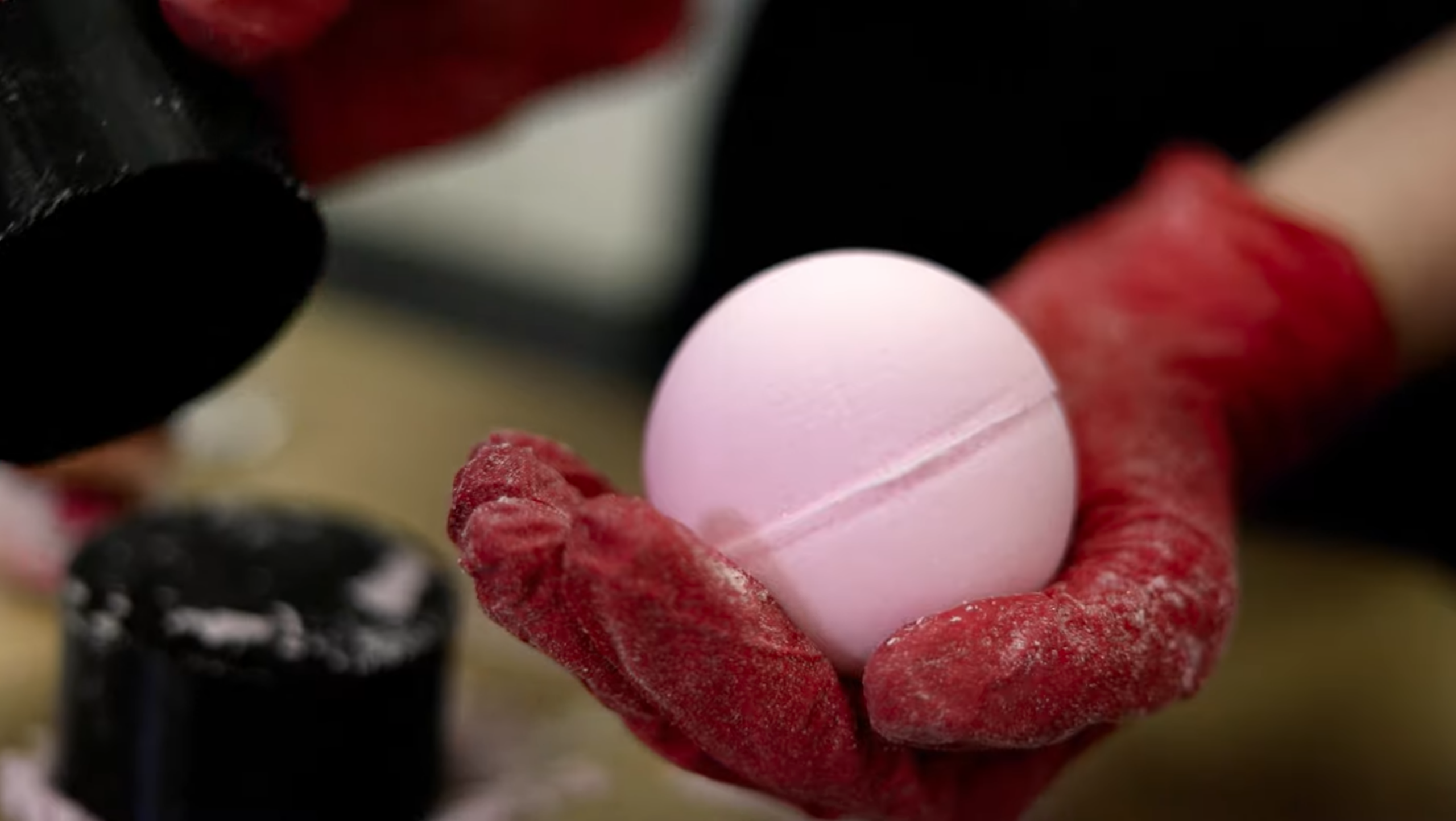
Let’s convert a bath bomb recipe into a professional formula.
Original Bath Bomb Recipe
Dry Ingredients
- 2 cups Baking Soda = 553g
- 1 cup Citric Acid = 238g
- ½ cup Arrowroot Starch = 75g
Wet Ingredients
- 3 tsp Fragrance Oil = 9g
- 2 tsp Polysorbate 80 = 8g
- 1 tsp Cocamidopropyl Betaine = 4g
- 1 tsp Glycerin = 5g
Total Formula Weight
553 + 238 + 75 + 9 + 8 + 4 + 5 = 892gConverting Ingredient Weights to Percentages
Percentage Calculations
| Ingredient | Weight | Percentage |
|---|---|---|
| Baking Soda | 553g | 62.0% |
| Citric Acid | 238g | 26.7% |
| Arrowroot Starch | 75g | 8.4% |
| Fragrance Oil | 9g | 1.1% |
| Polysorbate 80 | 8g | 0.9% |
| Cocamidopropyl Betaine | 4g | 0.4% |
| Glycerin | 5g | 0.5% |
Finished Bath Bomb Formula
Your formula now becomes:
- 62.0% Baking Soda
- 26.7% Citric Acid
- 8.4% Arrowroot Starch
- 1.1% Fragrance Oil
- 0.9% Polysorbate 80
- 0.4% Cocamidopropyl Betaine
- 0.5% Glycerin
Unlike a recipe, this formula can be scaled to virtually any batch size.
How to Scale a Formula Up or Down
One of the biggest advantages of formulas is scalability.
Suppose you want enough bath bomb mixture to fill:
- Five 8-ounce molds
Total batch size:
5 × 8 oz = 40 ozSimply multiply each percentage by 40.
Scaled Formula for 40 Ounces
| Ingredient | Amount |
|---|---|
| Baking Soda | 24.8 oz |
| Citric Acid | 10.68 oz |
| Arrowroot Starch | 3.36 oz |
| Fragrance Oil | 0.44 oz |
| Polysorbate 80 | 0.36 oz |
| Cocamidopropyl Betaine | 0.16 oz |
| Glycerin | 0.20 oz |
This approach allows you to produce exactly the amount you need without reworking the recipe.
Additional Benefits of Percentage-Based Formulation
Percentage formulations offer advantages beyond consistency and scalability.
Easier IFRA Compliance
When fragrance usage is expressed as a percentage, it’s much easier to compare your formula against IFRA maximum usage rates.
For example:
- Formula fragrance level = 1.1%
- IFRA limit = 5%
You can immediately verify compliance.
Easier Product Optimization
Small adjustments become easier to manage.
Examples include:
- Increasing fragrance from 1% to 1.5%
- Lowering surfactant levels
- Increasing moisturizers
- Adjusting additives
These changes can be documented and reproduced accurately.
Better Manufacturing Efficiency
Professional manufacturers use percentage formulas because they simplify:
- Scaling
- Documentation
- Quality control
- Batch records
- Production planning
Common Mistakes When Learning to Formulate
New formulators often make a few common mistakes.
Mixing Units
Never mix grams and ounces in the same calculation.
Forgetting to Total 100%
Always verify that ingredient percentages equal 100%.
Ignoring Restricted Ingredient Limits
Some ingredients have maximum usage rates that must be followed.
Examples include:
- Fragrance oils
- Preservatives
- Active ingredients
- Surfactants
Skipping Documentation
Always keep detailed records of your formulas and revisions.
Why Formulation Matters for Growing Businesses
If you’re serious about selling products, formulation eventually becomes a necessity.
Customers expect consistency.
Retailers expect consistency.
Manufacturing partners expect consistency.
Formulas help ensure every batch performs the same way while making it easier to scale production as demand grows.
Whether you’re producing bath bombs, soaps, candles, perfumes, room sprays, or personal care products, learning to formulate is one of the most valuable skills you can develop.
Take Control of Your Formulations
Transitioning from recipes to formulas is one of the most important milestones in a maker’s journey. By using weight-based measurements and percentage formulations, you’ll improve consistency, simplify scaling, and gain greater control over your products.
At Aromatic Fragrances International, we’re committed to helping makers and manufacturers succeed through educational resources, premium fragrance oils, and professional formulation support. Start formulating with our Fragrance Oils, or contact our team through our Contact Page if you need assistance selecting fragrances for your next formulation project.
Looking for inspiration? Explore our collection of free formulas, tutorials, and educational resources to continue growing your formulation skills.
Frequently Asked Questions
What is the difference between a recipe and a formula?
A recipe typically uses volume measurements such as cups and teaspoons, while a formula uses precise weight measurements and percentages for greater consistency and scalability.
Why do manufacturers use formulas instead of recipes?
Formulas provide consistent results, simplify scaling, improve quality control, and allow for more accurate regulatory compliance.
How do I convert a recipe into a formula?
Weigh each ingredient, calculate the total batch weight, divide each ingredient weight by the total weight, and convert the resulting decimals into percentages.
Why should formulas total 100%?
A complete formula represents the entire product composition. Ensuring all ingredients total 100% allows for accurate scaling and production calculations.
Can formulas be scaled to any batch size?
Yes. Percentage-based formulas can be scaled to virtually any batch size by multiplying ingredient percentages by the desired total weight.
Why is percentage formulation important for IFRA compliance?
Percentage-based formulas make it easy to compare fragrance usage levels against IFRA maximum usage rates and verify compliance.
What tools do I need to start formulating?
At minimum, you’ll need a digital scale, calculator, documentation method, and basic math skills.
Can formulas be used for candles, soaps, and bath bombs?
Yes. Percentage-based formulation can be used for nearly all fragranced products, including candles, soaps, bath bombs, perfumes, room sprays, and personal care products.